Fine-grained grounding
Select the intended target among visually similar candidates using geometry, distance, viewpoint, relations, and canonical indices.
RoboSPA is a large-scale robotic manipulation benchmark for diagnosing fine-grained spatial reasoning and long-horizon procedural planning.
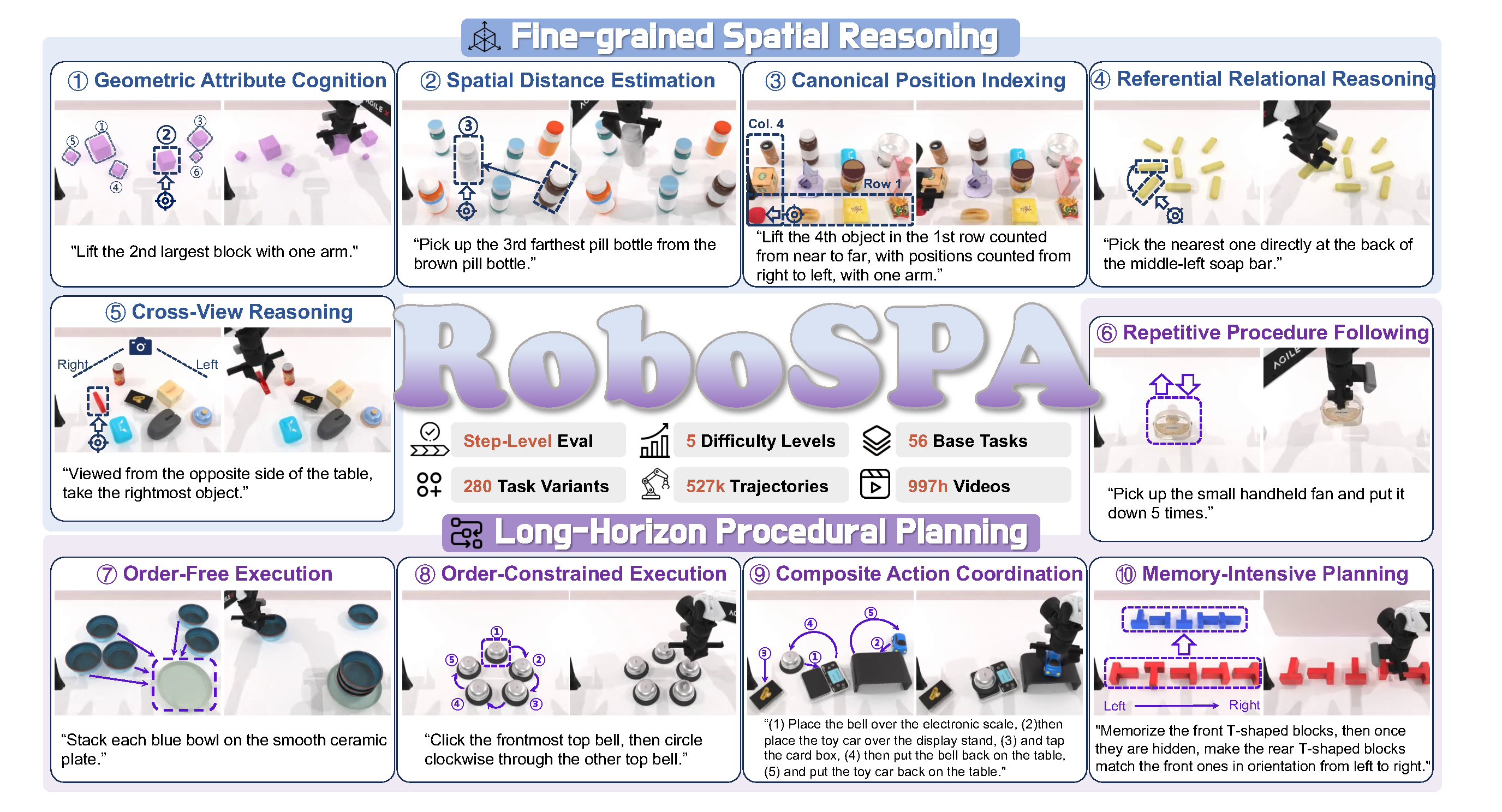
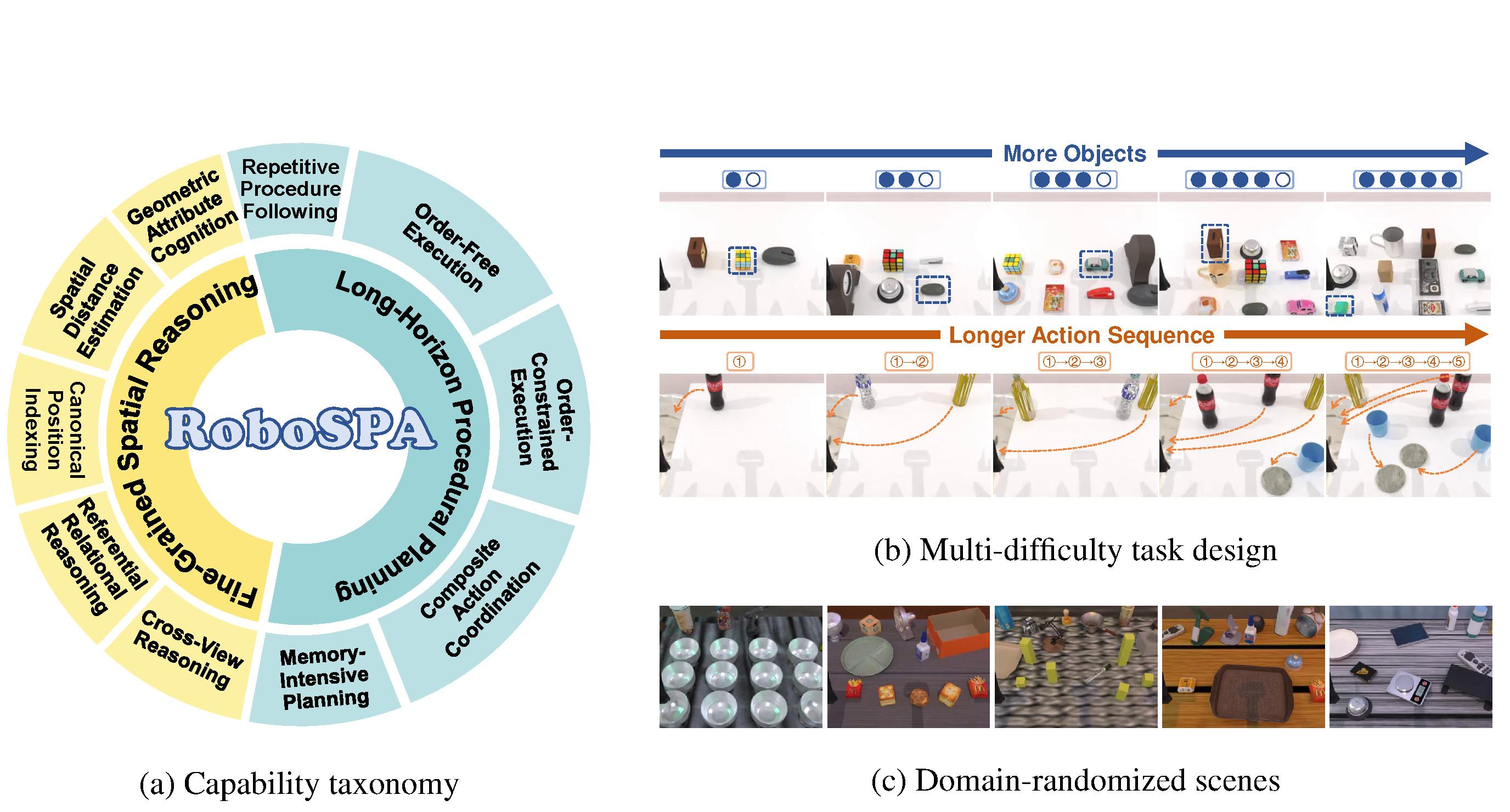
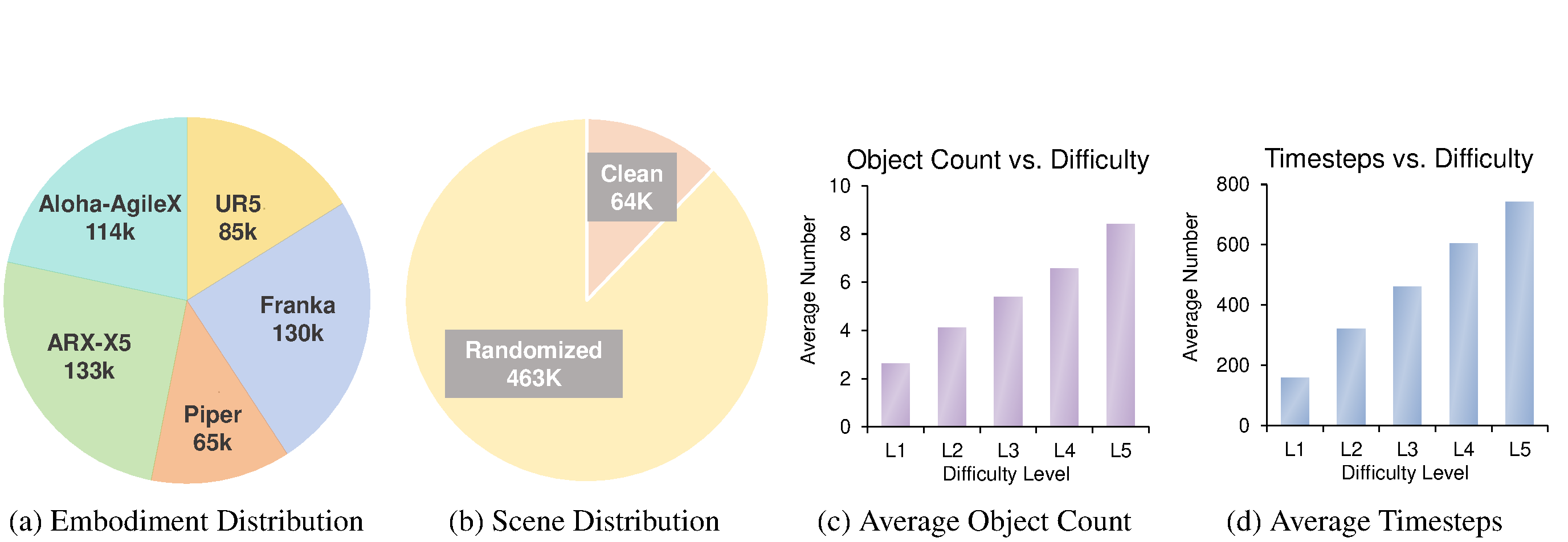
Vision-Language-Action (VLA) models have shown promising progress in language-conditioned robotic manipulation. However, existing datasets and benchmarks mainly evaluate task completion under predefined settings, offering limited insight into model reasoning under increasing spatial and procedural complexity. We introduce RoboSPA (Robot Spatial-Procedural Assessment), a large-scale robotic manipulation dataset and benchmark for diagnosing embodied reasoning in VLA models. RoboSPA focuses on two core dimensions, Fine-Grained Spatial Reasoning and Long-Horizon Procedural Planning, covering 10 task categories and 56 base tasks. Each task is instantiated across five difficulty levels, yielding 280 variants with increasing spatial ambiguity and procedural complexity. We collect 527K trajectories across multiple embodiments and diverse scenes. Beyond binary success rate, RoboSPA introduces diagnostic metrics for more detailed evaluation. Experiments on representative VLA models show that current systems still struggle with complex spatial relations, precise low-level execution, and memory-intensive planning. These results establish RoboSPA as a challenging diagnostic benchmark for developing more capable, reliable, and generalizable embodied agents. Our data and code are available at github.com/fanzhenxuan/RoboSPA.
Existing evaluations often stop at final success in clean, short tasks. RoboSPA scales ambiguity, action horizon, and scene diversity while preserving task semantics—making model limitations measurable.
Select the intended target among visually similar candidates using geometry, distance, viewpoint, relations, and canonical indices.
Complete multi-step procedures with repetition, ordering constraints, heterogeneous actions, and task-relevant memory.
Measure how behavior degrades as candidate counts, action horizons, distractors, and environment diversity increase.
Each category isolates a distinct reasoning bottleneck instead of treating manipulation tasks as undifferentiated successes or failures.
Identify objects by subtle geometric or shape-related attributes beyond category recognition.
Compare distances to a reference object and reason about relative proximity.
Ground row-column indices under different counting and scanning directions.
Locate targets through directional relations to reference objects.
Transform spatial references across non-egocentric viewpoints.
Spatial tasks add plausible candidates. Procedural tasks extend the sequence. Five aligned levels reveal when capability begins to break.
RoboSPA combines clean and domain-randomized scenes across Aloha-AgileX, ARX-X5, Piper, Franka, and UR5.
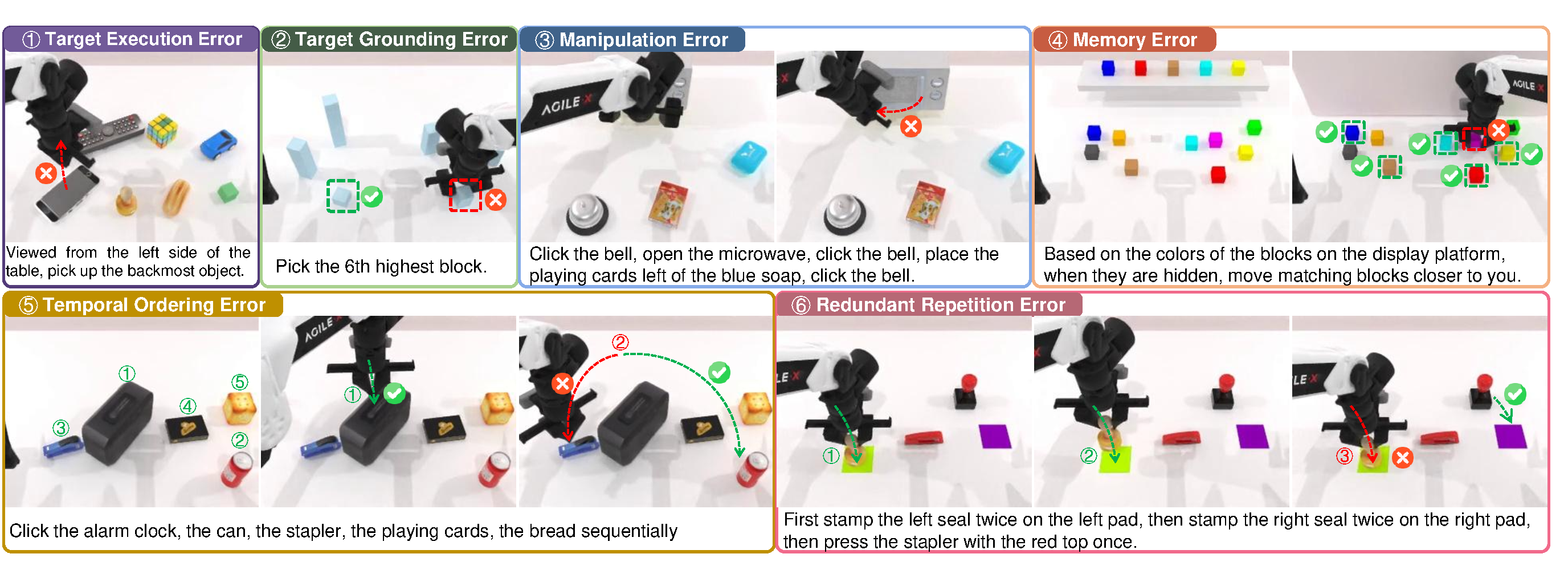
Low ONTA exposes unreliable grounding when identification depends on subtle relations instead of object category.
Progress Score exceeds final Success Rate, showing that models start procedures but fail to complete later stages reliably.
All baselines fail on the most difficult memory-intensive planning settings.
Step-level evaluation separates grounding, execution, ordering, repetition, and memory failures.
Access the paper, implementation, and dataset resources for RoboSPA.
@inproceedings{robospa2026,
  title     = {RoboSPA: Can VLA Models Go Beyond Simple Scenes and Short-Horizon Tasks?},
  author    = {Zhenxuan Fan and Bo Zhang and Yutong Lin and Yuqian Yuan and Juekai Lin and Liang Liang and Zhuoyi Huang and Wenqiao Zhang and Juncheng Li and Siliang Tang and Jun Xiao and Yueting Zhuang},
  booktitle = {Proceedings of EMNLP},
  year      = {2026}
}